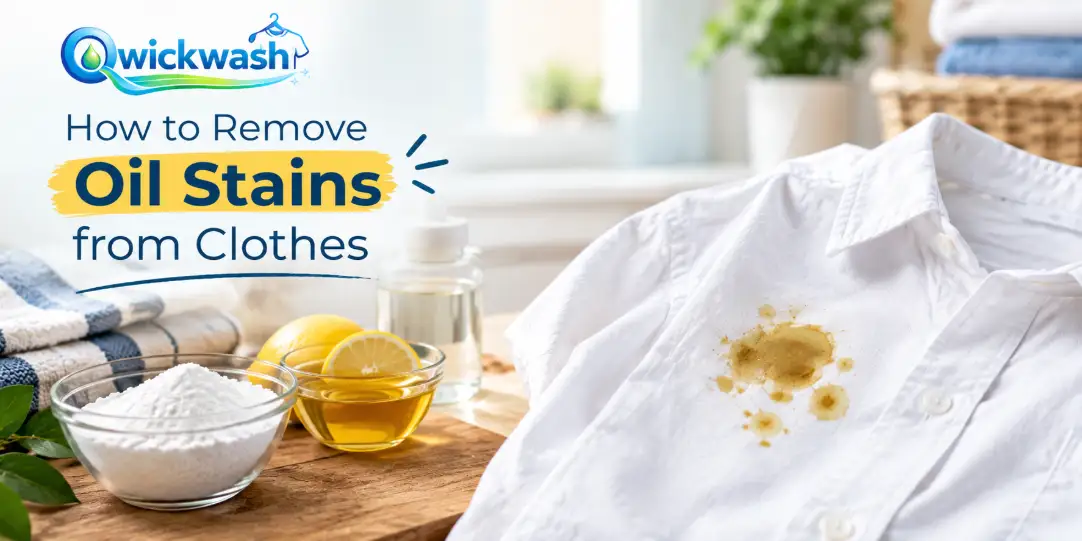
How to Remove Oil Stains from Clothes: A Fabric-Friendly Guide

Expert Byline
Qwick Wash Team
Release Date
October 12, 2026
Look, I spend most of my week debugging microservices, tracking down memory leaks, and managing infrastructure that likes to fail at 3 AM. So when I finally step away from the terminal to grab a decent meal or wrench on my car over the weekend, the last thing I want to deal with is a catastrophic failure on my favorite shirt.
But it happens. A rogue drop of olive oil from a slice of pizza. A smear of motor oil from checking the dipstick. Suddenly, you're staring at a dark, stubborn spot, frantically searching the internet for how to remove oil stains from clothes before the damage becomes permanent.
I treat oil stains exactly like a critical production bug. You don't just throw random soap at the problem and hope it compiles. You need to understand the root cause, isolate the environment, and apply the specific patch required to fix the issue. If you run the wrong protocol—like throwing a grease-stained shirt directly into a hot dryer—you hardcode that bug into the system forever.
Let's break this down. Grab a coffee. We're going to systematically troubleshoot how to get oil out of clothes, covering everything from fresh kitchen spills to that heavy black grease you picked up in the garage.
Table Of Contents:
The Physics of the Failure: Why Oil Hates Fabric
Before we patch the issue, you need to understand why it's broken.
Water and oil don't mix. You know this. It's basic chemistry. When you drop water on a shirt, it eventually evaporates. When you drop oil, it binds. Most synthetic fabrics—like polyester or nylon—are basically plastics, which are derived from petroleum. Oil is also petroleum-based or lipid-based. Like attracts like. The fabric fibers literally grab onto the oil molecules and refuse to let go.
This is why your standard wash cycle fails. You're trying to fix a hardware problem with a software update. Water just glides right over the grease. To figure out how to get rid of oil stains on clothes, we have to introduce a chemical agent that breaks that bond. We need surfactants.
The Immediate Hotfix: How to Remove a Grease Spot from Clothing Right Now
Time is your enemy here. If a server goes down, you don't wait three days to check the logs. If you drop a french fry on your lap, you act immediately.
When you're trying to figure out how to get oil out of fabric the second it happens, do not use water. And whatever you do, do not rub it. Rubbing just forces the lipid molecules deeper into the fabric matrix.
Here is the emergency response protocol:
- Blot the surface. Grab a paper towel, a napkin, whatever dry material you have. Press it directly onto the stain. Lift straight up. We want to absorb the excess payload before it settles.
- Deploy the absorbent cache. If you're at home, grab baking soda, cornstarch, or even baby powder. Dump a heavy pile of it directly onto the stain. This is your buffer. The powder is highly absorbent and will literally pull the oil out of the fibers through capillary action.
- Let it run. Leave the powder there for at least 30 to 60 minutes. Go write some code. Watch an episode of something. Let the chemical process do its job.
- Scrape it off. Once the powder looks clumpy (that's the oil it absorbed), brush it away with an old toothbrush or a piece of cardboard.
You've now stopped the bleeding. But you still need to know how to take oil stains out of clothes completely.
The Standard Protocol: How Do You Get Grease Stains Out of Clothes?
For 80% of your daily spills, this is the exact method I use. It doesn't matter if you're wondering how to get oil stain out of shirt collars or how to remove cooking oil stains from clothes. This is the baseline deployment.
The Tools (Your Tech Stack)
- Liquid dish soap (Dawn is the industry standard for a reason. They use it on ducks after oil spills. It has the heavy-duty surfactants we need).
- An old toothbrush.
- Baking soda.
- Cardboard.
The Execution
- Isolate the layer. Put a piece of cardboard inside the shirt, directly under the stain. If you don't do this, the oil will just bleed through to the back of the shirt, and now you have two bugs instead of one.
- Apply the surfactant. Squeeze the liquid dish soap directly onto the stain. Don't water it down yet.
- Agitate. Take that old toothbrush and gently work the soap into the fibers. You aren't scrubbing the floor; you're just coaxing the soap into the matrix of the fabric. If people ask me how do i get a oil stain out of clothes without ruining the weave, I tell them to use a soft brush and a light touch.
- Wait 15 minutes. The soap needs time to bind to the oil molecules.
- The Hot Water Flush. Wash the garment in the hottest water the care label allows. Heat lowers the viscosity of the oil, making it easier for the soap to carry it away.
- The QA Check. Take the clothes out of the wash. Look at the spot. Is it gone? If yes, you can dry it. If no, do not put it in the dryer.
I cannot stress this enough. The heat of a tumble dryer bakes the oil into the fibers. It's the equivalent of pushing broken code to the main branch. Always air dry until you are 100% sure the stain is gone.
If you are dealing with a massive amount of laundry or a stain you just don't have the bandwidth to fight, this is usually the point where I outsource. The team at Qwick Wash handles this stuff at scale. Their stain removal service uses commercial-grade solvents that we just can't keep under our sinks.
The Edge Cases: Fabric-Specific Configurations
Every fabric reacts differently to grease. You can't use the same command line prompt for Linux as you do for Windows. Same rules apply here.
How to Get Oil Stains Out of Jeans and Heavy Denim
Denim is tough. It's built for labor. But because the fibers are so densely woven, oil gets trapped deep inside the twill. If you're trying to figure out how to get oil out of pants made of heavy denim, you can afford to be more aggressive.
You can scrub harder with the toothbrush. If dish soap isn't cutting it, I've used mechanics' hand cleaner (the orange stuff with pumice in it). Work it into the denim, let it sit, and wash on heavy duty. Denim can take the abuse.
How to Get a Grease Stain Out of a Sweatshirt and Synthetics
Fleece, hoodies, and activewear are usually a blend of cotton and polyester. Remember what I said about polyester? It's plastic. It loves oil.
When people ask me how can i get grease stains out of clothes made of synthetic blends, the answer is patience. You might have to repeat the dish soap and hot water process two or three times. Do not use extreme heat on synthetic sweatshirts, as it will melt the microfibers and trap the oil forever.
How to Remove Oil Stain from Dress and Delicates
This is where I stop playing hero. If you drop salad dressing on a silk tie, a chiffon dress, or an expensive wool suit, do not dump dish soap on it. You will ruin the garment's texture and color.
If you're desperately Googling "how to remove oil stain from dress", stop right now. Blot it gently with a dry tissue, and take it to a professional. This requires dry cleaning. Dry cleaning doesn't use water; it uses specific chemical solvents designed exactly for lifting lipid-based stains without swelling the fabric fibers. It's worth the money to not destroy a $200 dress.
The Summer Wardrobe: Cotton and Linen
These natural plant fibers are highly porous. They absorb oil quickly, but they also release it relatively easily if you treat it fast. If you're wearing breathable fabrics (I highly recommend checking out this guide on the best fabrics to wear in summer), the standard dish soap and baking soda method works perfectly. Just watch the water temperature on linen, as it tends to shrink.
The Source Variables: Troubleshooting Different Types of Grease
Not all oil is created equal. The source of the leak determines the solvent you need.
Kitchen Nightmares: How to Get Cooking Oil Out of Clothes
Olive oil, vegetable oil, butter, and bacon grease. These are organic, animal, or plant-based fats. They are highly responsive to standard kitchen surfactants.
If you're asking how to get olive oil out of clothes or how to get vegetable oil out of clothes, Dawn dish soap is your best friend. Why? Because Dawn was engineered specifically to break down food grease.
Pro tip: If the butter or grease has hardened, don't just wash it. Scrape off the solid layer first with a butter knife. Otherwise, you're just pushing solid fat deeper into the fabric during the wash cycle.
Garage Grime: How to Get Motor Oil Out of Clothes
This is the brutal stuff. Motor oil, synthetic lubricants, black axle grease. These are heavy hydrocarbons. They contain carbon deposits, metal shavings, and chemical additives.
If you're working on a car and need to know how to remove motor oil from clothes or how to remove black grease from clothes, dish soap might not be enough. You need a heavy-duty degreaser.
- Aloe Vera Gel: Surprisingly, pure aloe vera gel contains amino acids that break down heavy mechanic grease. Rub it in, wash with hot water.
- Mechanic's Soap (Fast Orange/Gojo): Rub this directly into the stain before washing.
- Lestoil or Pine-Sol: These are heavy-duty pine-based solvents. Dab a little on the stain, let it sit for 20 minutes, then wash alone. (Warning: These smell terrible. Wash the clothes twice).
If you run an auto shop or a restaurant and you're constantly dealing with these heavy soils on uniforms, doing this manually is a massive waste of operational hours. You need to route that pipeline to a commercial laundry service that has ozone wash systems and industrial degreasers.
The Legacy Code: How to Remove Old Oil Stains from Clothes Home Remedies
This is the scenario everyone dreads. You washed the shirt. You didn't check the QA. You put it in the dryer. A week later, you pull it out of the closet, and there it is: a dark, shiny, permanent-looking spot.
You're frantically typing "how to remove set in grease stains" into your phone.
When a stain goes through the dryer, the heat chemically alters the lipids, bonding them to the fabric at a molecular level. It's essentially cured. Standard soap won't touch it because the oil is no longer "active."
We have to hack the stain. We have to reactivate it.
The WD-40 Hack (Yes, Really)
This sounds insane, but as an engineer, I respect things that work. WD-40 is a solvent. It breaks down old oil. If you want to know how to remove old grease stains from clothing, this is the brute-force method.
- Isolate: Put cardboard behind the stain. You must do this, or the WD-40 will stain the back of the shirt.
- Reactivate: Spray a tiny amount of WD-40 directly onto the old, dried grease spot. Or, apply it with a Q-tip for precision.
- Wait: Give it 5 to 10 minutes. The new, active solvents in the WD-40 are breaking down the old, cured oil bonds. The stain will look worse. Don't panic.
- Extract: Now that the oil is "wet" again, apply a heavy layer of Dawn dish soap over the WD-40. Work it in with a toothbrush.
- Wash: Wash on the hottest setting possible.
I've used this to figure out how to get old oil stains out of clothes that I thought were completely ruined. It takes effort, and it smells like a garage for a bit, but it saves the garment.
The Chalk Method (For smaller spots)
If you just have tiny splatters and want to know how to remove oil spots from clothes without aggressive chemicals, grab a piece of plain white blackboard chalk. Rub the chalk heavily over the old stain before you throw it in the hamper. The chalk absorbs the oils slowly over a few days. Then, treat with dish soap right before washing.
Rapid Fire Troubleshooting: Frequently Asked Questions
When you're the guy who knows how to fix things, people ask you a lot of questions. Over the years, I've heard every variation of this problem. Here is the rapid-fire documentation for getting oil out of fabric.
How do i get oil out of clothes if I don't have dish soap?
Use shampoo. Think about it. Shampoo is formulated to remove natural sebum (body oils) from human hair. If you have oily hair shampoo, even better. Rub it into the stain just like you would dish soap.
How can i remove grease stains from clothes using natural ingredients?
Mix baking soda and a few drops of white vinegar. It will fizz up. The chemical reaction helps lift the grease, while the baking soda acts as a mild abrasive to scrub the fibers clean.
How to remove an oil spot from clothes while I'm at a restaurant?
Go to the bathroom. Grab a paper towel and blot it immediately. Do not use hand soap from the dispenser—it often contains moisturizers (more oils!) that will make it worse. Just blot it dry. If you have artificial sweetener packets at the table (like Splenda or Sweet'N Low), tear one open and dump the fine powder on the stain to absorb the oil while you eat. Brush it off later.
How to get out a grease stain that covers the whole front of an apron or uniform?
Stop trying to spot-treat. If the saturation is that high, you need a soak. Fill a bucket or a sink with hot water, add a cup of heavy-duty laundry detergent and half a cup of dish soap. Let the whole garment soak overnight. If you're a business owner dealing with this, check out Qwick Wash's laundry services. Let the professionals handle the heavy lifting.
How do you take out grease stains from clothes that are dry-clean only?
You don't. Period. Take them to the cleaners. Tell the clerk exactly what kind of oil caused the stain. They need to know the specific bug they are patching so they can select the right solvent.
How to get oil off clothes if it's thick, like bicycle chain grease?
Scrape first. Use an old credit card or a dull knife to physically lift the thick grease off the surface. Then use the WD-40 or mechanic's soap method described above.
How can you remove oil stains from clothes that have already been washed multiple times?
You can try the WD-40 reactivation trick. But understand that every time it goes through the dryer, the success rate drops by about 50%. Sometimes, a shirt just has to be retired to "garage duty."
The Final QA: Preventing Future Stains
Fixing a bug is great. Preventing it from happening again is better.
- Audit your washing routine. Are you overloading your machine? If clothes don't have room to agitate, the soapy water can't pull the grease away.
- Check your detergent. Cheap detergents lack the necessary enzymes (specifically lipases, which break down fats) to effectively clean heavy soils.
- Always inspect before drying. Get into the habit of visually inspecting the collars, cuffs, and chest of your shirts before they go into the dryer.
Learning how to remove grease stains from fabric is just a matter of applying the right logic. Stop the spread, break the chemical bond, extract the residue, and never apply heat until the job is done.
It takes a little patience, and sometimes you have to get your hands dirty with a toothbrush and some dish soap. But it beats throwing away good clothes.
And look, if you just don't have the time to deal with this, or you're staring down a pile of grease-stained uniforms that need to look pristine by Monday morning, don't stress yourself out. Hand it off to the pros. You can schedule a pickup through Qwick Wash and let them run their proprietary stain removal protocols.
Sometimes, the best engineering decision is knowing when to outsource the infrastructure. Keep your code clean, and keep your clothes cleaner.
